

What the Mother Tree Knows
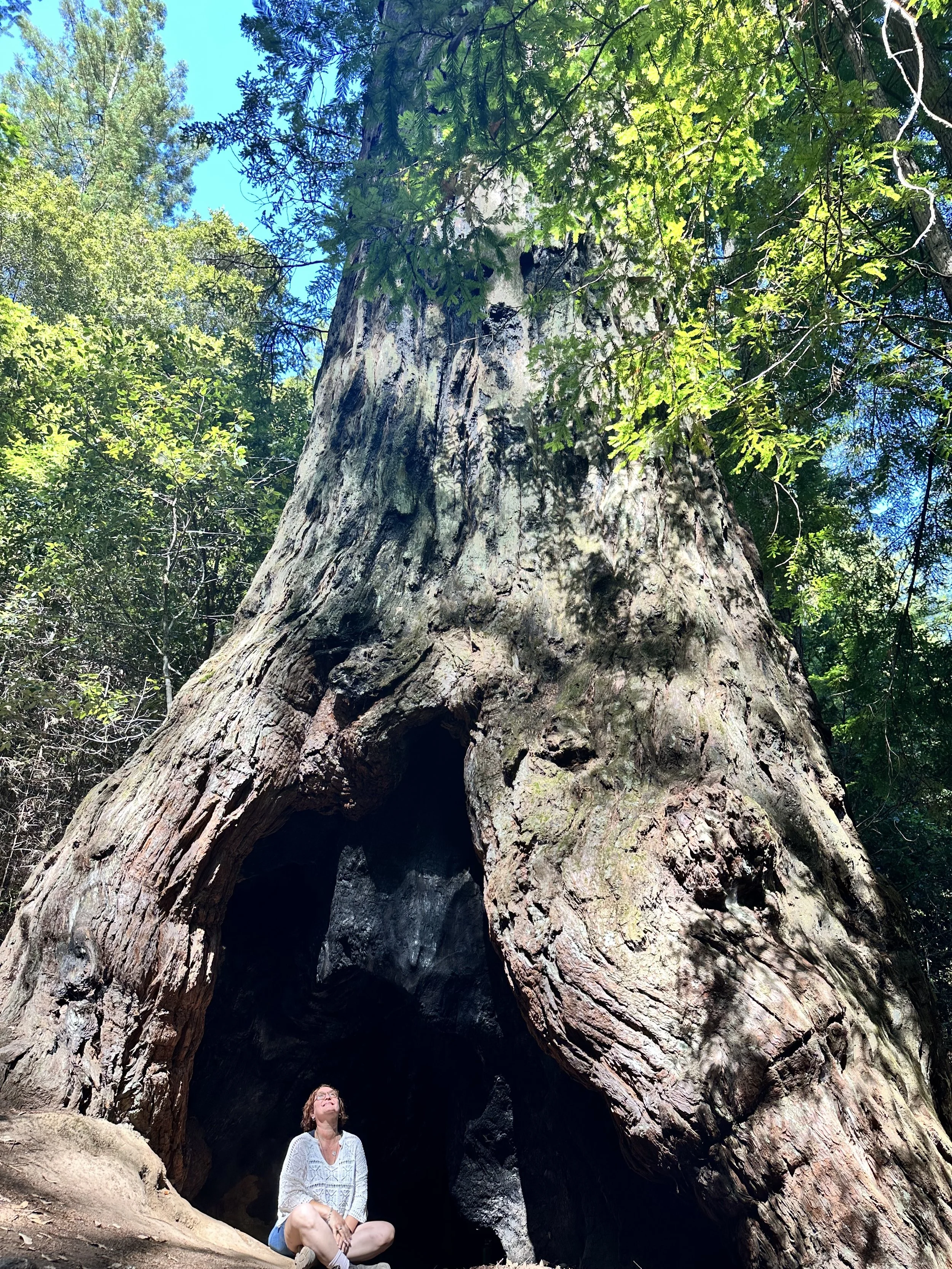
This summer I visited a tree that is more than 3,000 years old. I am very lucky to have spent several lovely weeks during the past two decades of summers in the redwood forests of the Mendocino Woodlands. And yet in all my visits, this was only my second time visiting this glorious tree.
For those of you who have read The Hidden Life of Trees or Braiding Sweetgrass or Finding the Mother Tree, you know we have learned about trees, and forests in particular, that they live communally, and that all the plants within the forest live symbiotically with all the others. Never has that been more apparent than walking the path to the Mother Tree. The ferns on the ground dig into the in-between spaces, and the gorgeous variety of plant life on the forest floor is both shielded from the harsh hours of sunlight and fed nutrients by the trees creating spots of thick canopy overhead.
The redwoods feed their understory in ways that are almost hard to believe. On the California coast, summer brings very little rain, but it brings plenty of fog, and a redwood's needles comb that fog right out of the air, gathering it into droplets that rain down on the forest floor below. When UC Berkeley ecologist Todd Dawson traced where the water in a redwood forest actually comes from, he found that about a third of the forest's annual water arrived as fog drip from the trees themselves, and that during the dry summer months, 66 percent of the water inside the understory plants came from fog that had first dripped from redwood foliage. The ferns I was walking past were, quite literally, drinking what these majestic giants gathered for them.
If you've spent any time in a corporate org chart, you may already be seeing it. The forest has a leadership structure. It has a canopy, a middle story, and a forest floor, and it has been running a remarkably effective resource-sharing model for a few million years longer than any of us.
Inside the Mother Tree
At the base of the Mother Tree there is a small cave, formed by her massive trunk, and big enough for a person to sit inside. I climbed in and sat with my back against her, and the forest went quiet around me. I felt my spine easily lengthen as I closed my eyes, the light dancing on my face filtered through the branches above. I felt my breathing slow, and my body relax into a felt a profound and easy peace.
People on the redwood coast have an old word for these hollows. They call them goosepens, because early settlers would sometimes keep their geese inside them. They form when a tree is wounded, by a fallen neighbor or a broken limb, and the exposed heartwood slowly decays and then burns, fire after fire, century after century. What struck me, sitting there, is that the cave exists because she survived. The living part of a redwood is a thin layer just beneath the bark, and as long as enough of her trunk stands to carry water up to her crown, she can go on living for centuries around the very place where the fire got in. The wound became a shelter. The place where she was burned is now the place where I could rest.
Sitting inside her, I had a sense memory of the ages and times she had seen. She was already ancient when Europeans first mapped this coastline. She has watched the Pomo people tend this land for generations upon generations. She has stood through droughts and floods, fires and logging, world wars, the Great Depression, and the building of the Mendocino Woodlands camps as part of FDR’s New Deal. (One of only two such camps remaining, the other being Camp David.)
In her presence, my own struggles that had felt so enormous on the drive up, the unanswered emails, the client problem I hadn't solved yet-the worry about whether I am building my business fast enough-began to feel like what they are in the life of a forest: a bit of bad weather.
The Science of Getting Small
That feeling has a name. Psychologists call it awe, and UC Berkeley's Dacher Keltner has spent much of his career studying what it does to us. One of my favorite studies from his lab took place in a grove of towering eucalyptus trees right on the Berkeley campus. Researchers asked one group of people to look up into the trees for just one minute, and another group to spend that same minute looking at a tall building nearby. Then a researcher "accidentally" dropped a handful of pens. The people who had spent a minute gazing up at the trees picked up more pens to help. The researchers, led by Paul Piff, found across several studies that awe gives us what they call a "small self," a sense that we are part of something much larger than our own concerns, and that this small self makes us more generous and more attuned to others.
If you live in back-to-back meetings, this next one is for you. Researchers Melanie Rudd, Kathleen Vohs, and Jennifer Aaker found that experiencing awe changes our sense of time. People who had just felt awe reported feeling like they had more time available, and they became more patient and more willing to give their time to help others. Think about that for a moment. The thing most of us say we're short on at work is time, and one of the most reliable ways to feel like we have more of it is to spend a minute looking at something vast.
This is the gift of perspective. It doesn't make our problems disappear, but it puts them in their proper size. It turns our attention outward, toward the people around us. And for anyone who leads a team, a leader who can see the size of a problem accurately, and who has a little patience left over for the people working on it, is worth their weight in gold.
Forest Bathing
The Japanese have a practice for this. In 1982, Japan's Forest Agency introduced shinrin-yoku, which translates to "forest bathing," as part of a national health program for managing stress. It isn't hiking and it isn't exercise. It is simply being in the forest slowly and with all of your senses, letting the forest wash over you the way water does in a bath.
Dr. Qing Li of Nippon Medical School in Tokyo has spent nearly two decades studying what happens in our bodies when we do this, and his findings are remarkable. Time spent in the forest has been shown to lower stress hormones like cortisol and adrenaline and to reduce blood pressure compared with walking in a city. In his studies, forest trips significantly increased the activity and number of natural soldier cells, part of the immune system's front line, with effects that lasted more than a week. Li believes part of the effect comes from phytoncides, the aromatic compounds trees release into the air, which is to say that the smell of the forest itself may be part of the medicine.
Now, I know most of you can't slip away to the redwoods between your 2:00 and your 3:00. The good news is that even a small dose seems to matter. In a study at the University of Melbourne, Kate Lee and her colleagues gave people a tedious, attention-draining computer task and a 40-second break in the middle of it. Half of them spent those 40 seconds looking at an image of a green, flowering rooftop, and half looked at a bare concrete one. The people who looked at the greenery made significantly fewer errors and held their concentration better for the rest of the task. Forty seconds. That's less time than it takes most of us to find the mute button.
What the Trees Teach Us
Sitting in that small cave at the base of the Mother Tree, I found myself thinking about everything she could teach us, if we're willing to slow down long enough to learn. And because I've spent most of my career inside organizations, I couldn't help translating each lesson into the language of the workplace and relationships.
Trees teach us to endure. A redwood's bark can be a foot thick, and it is rich in tannins that help it resist fire, insects, and rot. But what moves me most is that her endurance isn't about never experiencing difficulty. She carries her wounds openly, and she keeps growing around them.
Most of us have lived through our own fire seasons at work: the layoff, the reorg, the product launch that went sideways, the acquisition that changed everything overnight. The leaders I've admired most are not the ones who were never burned. They're the ones who let those experiences hollow out a little space where someone else could take shelter, the manager who says "I've been through one of these before, and here's what I learned," and means it.
Trees teach us to care for the weaker among us. When a redwood is injured or falls, new sprouts often rise from its roots, forming the circles of young trees known as fairy rings. For years, those young trees are fed through the established root system of the tree they grew from. And every summer, the fog she gathers becomes the water her ferns drink.
At work, this is what a good manager does. They gather what's in the air above them, the strategy, the context, the shifting priorities from the executive floor, and they turn it into something their team can take in. Gallup's research has found for years that managers account for roughly 70 percent of the variance in team engagement. In other words, the person directly above you has more to do with whether you thrive than almost anything else about your job. Harvard's Amy Edmondson calls the conditions a good canopy creates psychological safety, the shared belief that it's safe to take a risk, ask a question, or admit a mistake without being punished for it. Google's own research into what makes its best teams work found that psychological safety mattered more than anything else.
Trees teach us to share resources. Redwoods have surprisingly shallow roots for such enormous trees, often only six to twelve feet deep, but those roots can reach out a hundred feet from the trunk, and they intertwine with the roots of their neighbors. Forest ecologist Suzanne Simard, whose research inspired the idea of the "mother tree," showed back in 1997 that carbon can move between trees through the mycelium underground. While the science on how much, how often, and how intentionally trees share through those networks is still being actively debated, the sharing I could see with my own eyes, the canopy shading the understory, the fog feeding the ferns, the roots braided together, needs no peer review.
Organizations, unfortunately, are often much better at hoarding resources rather than sharing. Researchers call it knowledge hiding, which McMaster University professor Catherine Connelly and her colleagues define as the intentional withholding of knowledge that a colleague has asked for. It shows up as the vague answer, the "I'll get back to you," the spreadsheet that only one person knows how to update. In my years running operations, I've watched companies scale around this dysfunction, where employees compete with one another for resources rather than sharing openly, whether it be information, credit, budget, or attention, ultimately limiting the company’s success. A forest where every tree kept its water to itself wouldn't be a forest for very long.
Trees teach us that if everything is shared, there is always enough. Robin Wall Kimmerer, the botanist and member of the Citizen Potawatomi Nation who wrote Braiding Sweetgrass, puts it in four words that I keep coming back to: "All flourishing is mutual." A forest doesn't run on scarcity. It runs on circulation.
Anyone who has sat through a budget cut knows how quickly a scarcity mindset takes over a team. Economist Sendhil Mullainathan and psychologist Eldar Shafir, in their book Scarcity, describe what happens next. When we feel we don't have enough, our attention narrows into a kind of tunnel vision. We get very focused on the immediate shortfall and lose the mental bandwidth for everything else, including planning, creativity, and generosity. Teams that feel scarce start guarding their territory, and that guarding creates exactly the shortage everyone was afraid of. Circulation is the antidote.
And for the moments when there is not enough, trees teach us that being together in community makes it easier to endure. A redwood standing alone, with its shallow roots, would be at the mercy of every winter storm. It is the grove that holds each tree upright. Their roots are woven together so tightly that when the wind comes, they bear it together.
Right now, a lot of people at work are standing alone in the wind. Gallup's 2026 State of the Global Workplace report found that global employee engagement fell to 20 percent in 2025, its lowest level since 2020, and the steepest drop was among managers, whose engagement has fallen from 31 percent in 2022 to 22 percent. Leaders in the report described more stress, sadness, and loneliness than the individual contributors they lead. We have been asking our canopy trees to shade everyone below them without anyone holding up their roots.
Where Are You in the Forest?
I've been sitting with what all this means for the people I work with, and for myself, at this stage of life.
If you're a senior leader or a founder, you are the canopy, and your job is bigger than growing taller. The question for you is what you are gathering for the people below you. What fog are you combing out of the air for your ferns?
If you're a middle manager, you may be living in the most demanding part of the forest, the understory trees that receive shade from above and are expected to provide it below. You are gathering context from leadership, translating it for your team, and absorbing weather from both directions. You deserve a grove of your own, peers whose roots are woven with yours, and I hope you'll go looking for one.
If you're newer in your career, or new to a company, you are the fern and the sapling, and your job is to thirstily drink in what the giants gather. That's how forests work. You grow your roots to one day become someone else's shade.
And for those of us in midlife, in transition, or in reinvention, the Mother Tree offers a different picture of aging than the one we're usually sold, especially in corporate life. She doesn't grow smaller with age. She grows more generous. Her burns have become shelter, her height has become canopy, and her long life has become perspective she can offer to everything growing around her. I love the idea that the places where life has burned us might someday become the very places where someone else can sit and rest. That's what Proserpina Returns has always been about for me: the understanding that we go down into the dark, and we come back, and we bring something back with us that is worth sharing.
The healthiest organizations I've ever been part of worked like a grove. The senior people created canopy, protecting newer team members from the harshest exposure while they grew their roots. Knowledge circulated freely. And when a hard season came, a layoff or a missed quarter or a market shift, teams that had woven their roots together stayed standing, while the ones that had grown as isolated individuals toppled in the first strong wind.
